Remote teams, international clients, family abroad — scheduling across time zones is a small problem that causes a disproportionate amount of confusion, mostly because "3 PM" is meaningless without saying whose 3 PM.
The Core Rule
Always state a time with its time zone attached — "3 PM EST" or "3 PM my time (GMT+5)" — never just "3 PM." If you're the one proposing the time, convert it to the other person's zone yourself rather than making them do the math.
Convert Instantly
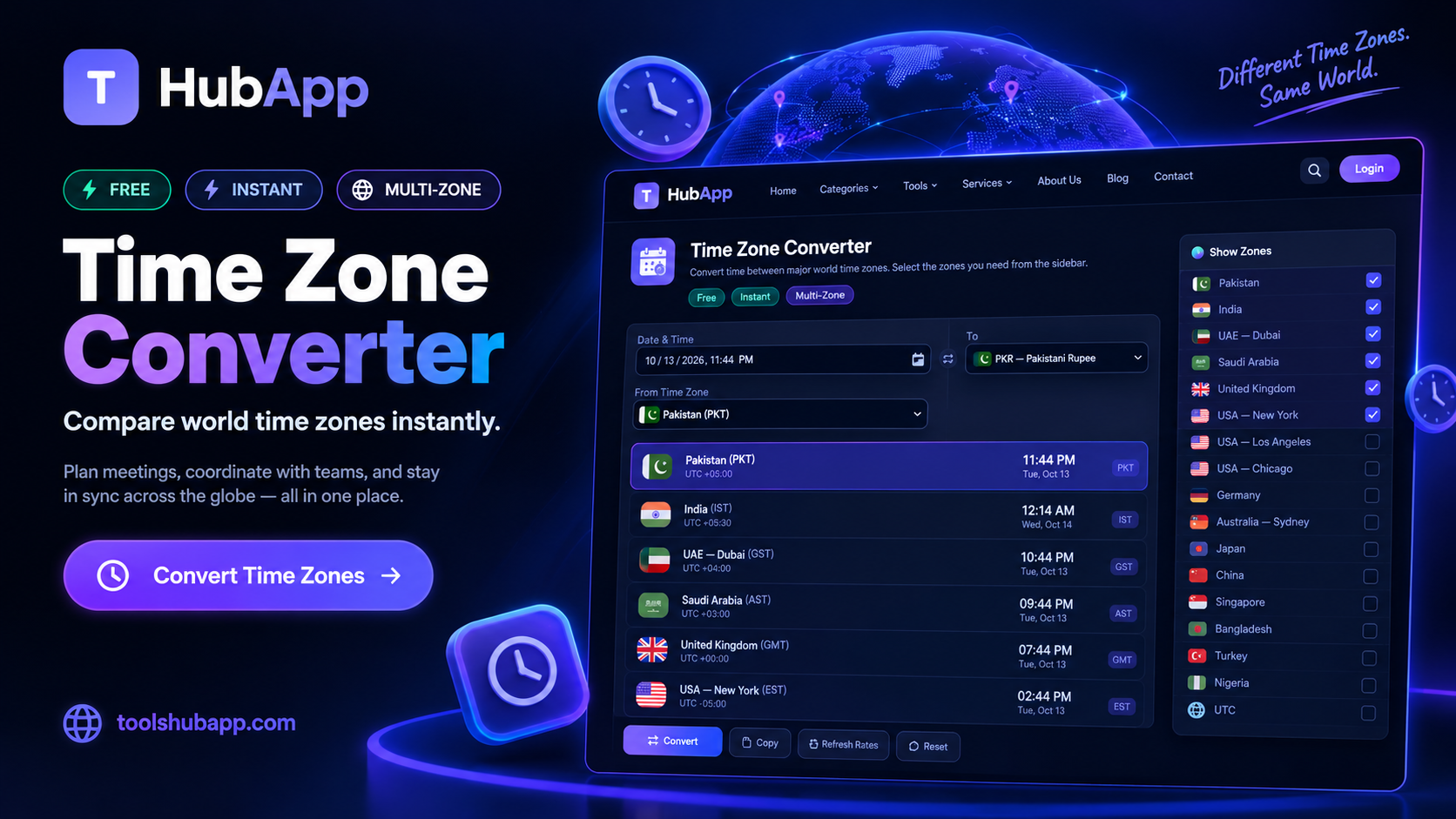
The Time Zone Converter shows what time it is anywhere relative to your own, so you can pick a meeting time and immediately see what it translates to for everyone else on the call.
Daylight Saving Time: The Real Source of Confusion
Time zone offsets aren't fixed year-round in places that observe Daylight Saving Time (DST) — a location can be GMT+5 for part of the year and GMT+6 for the rest. This is why a meeting scheduled months in advance can quietly shift by an hour if the DST transition happens in between, and why relying on a fixed offset instead of a proper time zone name causes recurring meetings to drift wrong twice a year.
Practical Scheduling Tips
- Use calendar invites with time zone data rather than typing a plain time in a message — most calendar apps auto-adjust the displayed time for each attendee.
- Avoid "your morning, my evening" phrasing when precision matters — state the actual clock time in a specific zone instead.
- For recurring meetings spanning a DST change, double-check the time a week before the transition, since one side's local time may shift while the other's doesn't.
FAQ
What's the difference between GMT and UTC?
For practical scheduling purposes they're the same reference point — UTC is the modern standard, GMT is the older name still commonly used interchangeably.
Do all countries observe Daylight Saving Time?
No — many countries near the equator don't observe DST at all, since day length there doesn't vary much across seasons.
What's the best time to schedule a meeting across very different time zones?
Look for the overlap in each side's normal working hours — for a large time gap, this is often a narrow early-morning or late-afternoon window for one side.